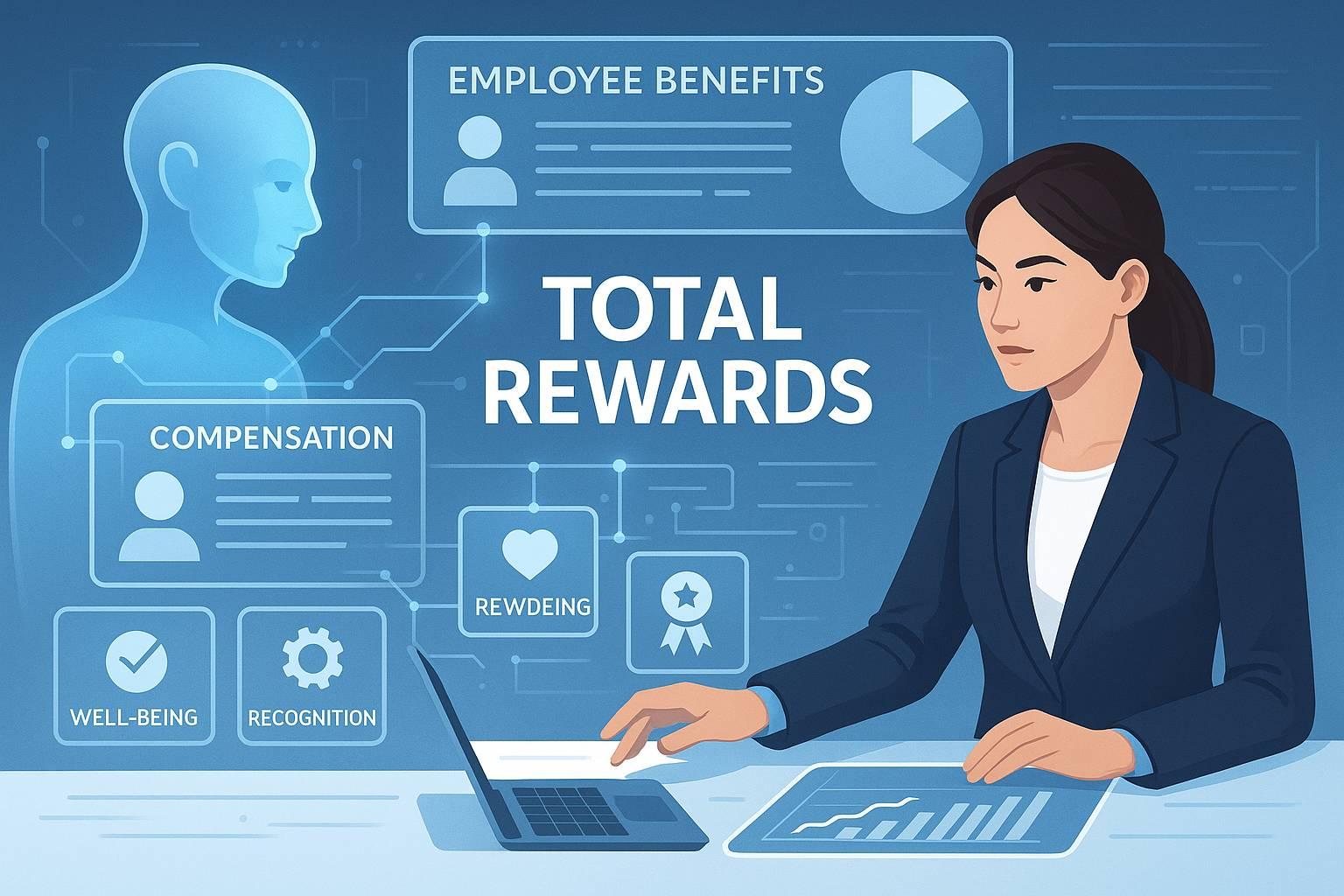
Revolutionizing Total Rewards with Agentic AI: The Future Is Here
Let’s face it—most Total Rewards systems today aren’t delivering on their promise. Despite significant investments, organizations struggle with outdated platforms, employees feel undervalued, and HR teams spend too much time on administration rather than strategy. But there’s good news on the horizon: agentic AI is set to transform how we approach Total Rewards, solving problems that have plagued HR departments for years.
In this edition, we’ll explore the current challenges, their impact on both your team and your organization, and how the emerging field of agentic AI offers transformative solutions that could revolutionize your Total Rewards strategy.
The Pain Points You’re Likely Facing Right Now
1. Data Everywhere, Insights Nowhere
If you’re like most HR leaders, you’re dealing with a fragmented technology landscape. Your compensation data lives in one system, benefits in another, wellness programs in a third, and recognition somewhere else entirely. Sound familiar?
This fragmentation creates real headaches:
- You can’t get a holistic view of your Total Rewards investment
- Your team wastes valuable time reconciling data manually
- It’s practically impossible to understand the relationships between different rewards components
- Global operations? The problem multiplies with each region
As one HR leader recently told me, “We have all this data, but turning it into something useful feels like trying to complete a jigsaw puzzle with pieces from different boxes.”
2. One-Size-Fits-Few Rewards
Despite all the talk about personalization, most Total Rewards programs still take a remarkably standardized approach:
- Generation Z employees get the same benefits package as Baby Boomers
- High performers receive essentially the same rewards as average performers
- Life changes (marriage, children, caring for parents) rarely trigger rewards adjustments
- Scaling personalization beyond a few executives seems impossible
The data confirms this is a major issue. According to Gallup, only 23% of employees feel they get recognized enough for their work. Similarly, only 41% believe their companies adequately compensate them for their hard work. This disconnect creates a significant gap between what organizations invest and how employees value it.
3. Stone-Age Technology in a Space-Age World
While AI has made inroads in many business functions, Total Rewards systems often seem stuck in the past:
- Basic automation at best, manual processes at worst
- Little to no predictive capabilities
- Limited decision support for rewards optimization
- Integration between systems feels like trying to connect LEGO to Duplo
As one CHRO recently confided, “We’re spending millions on our rewards, but our systems for managing them feel like they’re from the 1990s.”
4. The Communication Black Hole
Even the best-designed Total Rewards programs fail when employees don’t understand them:
- Annual benefits statements that promptly get filed away (or trashed)
- Complex explanations of programs that leave employees confused
- One-way communication rather than interactive exploration
- Little to no feedback on what employees actually value
When employees don’t understand what they have, they significantly undervalue it—leaving you with a poor return on your substantial investment.
5. Measuring Impact? Good Luck With That
Try answering these questions about your Total Rewards program:
- Which elements deliver the highest ROI?
- How do different rewards components influence retention?
- What’s the actual impact of your wellness program on productivity?
- How should you adjust your strategy based on changing business conditions?
If you struggle to answer with confidence, you’re not alone. Most organizations lack the tools to measure and optimize their Total Rewards investment effectively.
What This Means for Your People and Your Business
The Impact on Your Employees
These limitations are affecting your workforce in concrete ways:
- Frustration: Employees receiving benefits that don’t match their needs feel undervalued and frustrated.
- Missed opportunities: Without understanding what’s available, employees miss out on valuable benefits they’re already entitled to.
- Inequitable experiences: Without sophisticated analytics, unconscious biases can creep into rewards decisions.
- Wasted time: Employees spend valuable time navigating complex systems just to understand their benefits.
- Disconnection: Without seeing how performance links to rewards, motivation suffers.
The Impact on Your Organization
The business consequences are equally significant:
- Money down the drain: You’re spending millions on benefits that go unused or unappreciated.
- Talent walking out the door: According to a Korn Ferry report, 93% of companies are concerned about employee retention, with first-year attrition in the U.S. and U.K. about 20% higher than pre-pandemic levels.
- Competitive disadvantage: Organizations with personalized, well-communicated rewards have a significant edge in the talent market.
- Administrative overhead: Your HR team spends countless hours on manual processes that add little strategic value.
- Missed optimization opportunities: Without data-driven insights, you can’t optimize your rewards spending for maximum impact.
The good news? A culture of recognition alone can save a 10,000-employee organization up to $16.1 million annually in turnover costs (Gallup, 2022). Imagine what a fully optimized Total Rewards strategy could do.
How Agentic AI Changes the Game
You’ve likely heard about AI in HR before, but agentic AI represents something fundamentally different. Unlike simple automation or even generative AI, agentic AI can autonomously plan and execute complex tasks across multiple systems with minimal human intervention. It’s like having a specialized HR assistant who works 24/7, learns continuously, and executes consistently.
Here’s how it transforms Total Rewards:
1. From Fragmentation to Integration
Agentic AI can serve as the connective tissue between your disparate systems:
- Autonomous data orchestration: AI agents continuously gather, reconcile, and harmonize data across your HR systems without manual intervention.
- Cross-component analytics: Agents analyze relationships between different rewards elements to identify optimization opportunities you’d never see otherwise.
- Real-time data cleansing: They continuously monitor and correct data inconsistencies across platforms.
One financial services company implemented agentic AI for data integration and reduced their manual data reconciliation time by 85%, freeing their team for strategic work while improving data accuracy.
2. True Personalization at Scale
Forget one-size-fits-all. Agentic AI makes mass personalization not just possible but efficient:
- Individualized packages: AI agents analyze employee preferences, demographics, and life events to recommend tailored rewards combinations.
- Dynamic adaptation: They continuously monitor changing circumstances to proactively suggest adjustments.
- Preference learning: The system improves over time by learning from employee choices and feedback.
This personalization addresses a critical need: Mercer research shows that when asked how their compensation could improve, workers’ top response was more types of rewards and personalization. Many would even give up a 10% pay raise for other incentives—46% would prefer more well-being benefits, 26% would choose paid trainings, and 21% would opt for work-from-anywhere setups.
3. Next-Generation Technology Integration
Agentic AI represents a quantum leap beyond basic automation:
- End-to-end process automation: Agents work across multiple HR platforms to complete complex workflows without human intervention.
- Intelligent decision support: They provide sophisticated recommendations for rewards optimization based on multidimensional analysis.
- Proactive problem-solving: They identify and resolve issues before they impact employees.
A 2024 Asana report revealed that 54% of knowledge workers’ time is spent on “busy work”—repetitive administrative tasks that AI agents can automate. For HR teams specifically, automating routine tasks can save at least half a day per week per team member.
4. Communication That Actually Works
Agentic AI transforms how employees experience and interact with their rewards:
- Contextual communication: AI agents identify the perfect moment to highlight relevant rewards based on employee circumstances and life events.
- Interactive exploration: They enable sophisticated self-service tools that help employees understand and maximize their rewards.
- Continuous feedback: They gather and analyze employee sentiment about rewards programs to drive improvements.
Organizations with AI-enhanced rewards communication have seen up to 40-50% increases in employee awareness of available benefits, significantly improving perceived value and utilization.
5. Measurement That Drives Decisions
Agentic AI delivers unprecedented visibility into rewards effectiveness:
- Predictive ROI analysis: Forecast the likely impact of rewards changes on key metrics like retention and engagement.
- Attribution modeling: Identify which rewards elements drive the greatest business impact.
- Scenario planning: Model different rewards strategies to identify optimal approaches.
According to a Mercer study, companies regularly reviewing and adjusting their reward strategies are 1.5 times more likely to report financial performance significantly above their peers. Agentic AI makes this continuous optimization possible.
What’s Coming Next: The Future of Total Rewards
The evolution of agentic AI is opening up exciting new possibilities for the future of Total Rewards:
1. Rewards on Autopilot
Future systems won’t just analyze but actively optimize your Total Rewards:
- AI agents that autonomously adjust rewards allocations based on changing business conditions and employee needs
- Continuous A/B testing of different strategies to identify what works best
- Self-learning systems that improve over time without human guidance
A UiPath survey of US IT executives from companies with $1 billion or more in revenue found that 93% are highly interested in agentic AI for their business. These autonomous systems could reduce Total Rewards administration costs by 30-40% while improving outcomes.
2. Hyper-Personalized Experience Design
Beyond simple personalization, future systems will design comprehensive rewards experiences:
- AI-crafted rewards “journeys” tailored to individual career paths and life stages
- Predictive offerings that anticipate needs before employees even recognize them
- Integration of rewards with work design and productivity tools
Organizations pioneering in this space report up to 35% improvements in employee satisfaction and retention.
3. Ecosystem Integration Beyond Boundaries
Future agentic AI will extend beyond organizational boundaries:
- Seamless integration with external benefits providers for real-time service delivery
- Coordination with financial wellness platforms to optimize rewards for financial goals
- Connectivity with healthcare systems to maximize well-being impact
These ecosystem approaches could increase the perceived value of Total Rewards by 25-30% without increasing costs.
4. Human-AI Teams Reimagined
The most sophisticated future systems will redefine how HR professionals and AI work together:
- AI agents that function as full team members with specific roles and responsibilities
- Human supervision focused on strategy and ethics rather than transactions
- Collaborative decision-making that leverages both human judgment and AI analysis
Research from Asana shows that daily users of AI are 63% more likely than monthly users to view AI as a teammate. As ServiceNow’s CDIO Kellie Romack notes, “We’re not just automating a handful of manual tasks and processes across a department or two, we’re infusing AI agents everywhere to reimagine how we work and drive measurable value.”
Making the Leap: Your Next Steps
The limitations of traditional Total Rewards systems are costing you—in employee engagement, talent retention, and missed opportunities. But agentic AI offers a path forward that transforms fragmentation into integration, standardization into personalization, and confusion into clarity.
According to Willis Towers Watson, only 26% of North American employers report being effective at both managing and paying for performance, highlighting the significant opportunity for improvement. Early adopters are already seeing the benefits: Intuit’s implementation of agentic AI has helped their QuickBooks Online customers get paid an average of five days faster, with overdue invoices 10% more likely to be paid in full. Similar gains await HR organizations that move quickly.
So what should you do now?
- Assess your current state: Identify where fragmentation, standardization, and measurement gaps are hurting you most
- Start small but think big: Begin with a focused use case while developing a comprehensive vision
- Partner wisely: Look for vendors who understand both Total Rewards and agentic AI
- Build for integration: Ensure any solution can connect your existing systems rather than creating yet another silo
The future of Total Rewards isn’t just about more technology—it’s about smarter technology that transforms the employee experience while delivering measurable business impact. Organizations that embrace agentic AI won’t just achieve incremental improvements; they’ll create fundamentally different experiences that drive substantial competitive advantage in the talent marketplace.
Are you ready to join them?
What’s your experience with AI in Total Rewards? I’d love to hear your thoughts and questions. Reply to this newsletter or reach out directly to continue the conversation!
Shameless plug:
Do you know someone who can benefit by learning the fundamentals of Artificial Intelligence (AI) and Machine Learning (ML)? You are in luck!
I have created a fundamental course on AI/ML where I explain this complex topic is the most simply way - some of my students calls it “oversimplifying”!
Click on this link and gift them the course - and yes, they do not need technical background. I mean it - else they get their money back! Guarantee!
{{ address }}
Unsubscribe · Preferences